
The political kerfuffle of the week is quickly fading away, as modern political kerfuffles usually do, and so maybe it’s time to point out the obvious regarding the Biden Cover-up frenzy that’s now mercifully easing: Democrats, bad, very bad, for covering up Joe Biden’s mental state while at same time hypocritically questioning Donald Trump’s mental state. Just as it’s bad, very bad, for Republicans to remain silent about Trump’s mental state while at the same time hypocritically questioning what Dems knew about Biden’s mental state. … The Globe’s Jeff Jacoby tackled the issue of partisan hackery and hypocrisy back in January. And Bill Maher was attacking political hypocrisy in general the other night. …
-
Political Hypocrisy Alert: the Biden Cover-up vs. Trump Silence
-
Healey can’t distance herself fast enough from the shelter debacle
Do you think Gov. Maura Healey on Monday knew what was coming the following day? As you may vaguely recall (or not), the governor earlier this week announced plans to quicken the pace of closing hotel shelters for the homeless and newly arrived immigrants. The next day, state Auditor Diana DiZoglio slammed the Healey administration for approving ‘unlawful’ no-bid contracts for the controversial shelter program. … So to answer the opening question: Yeah, Healey knew what was coming. The Herald’s Joe Battenfeld agrees, saying DiZoglio’s harsh criticism could be a preview of a Healey-DiZoglio clash for governor. I don’t know about that. As I’ve previously noted, the time’s not right for DiZoglio, who’s young and can afford to wait.
As for the shelter program, Healey has known for a while that it’s a complete boondoggle, costing the state a billion dollars a year before she and other state leaders finally imposed some common-sense restraints on an out-of-control program that threatened the state’s fiscal health, not to mention threatened certain Dems’ political futures. Healey, who’s running for re-election, didn’t need Diana DiZoglio’s prodding to act. Next year’s gubernatorial election is motivation enough. The shelter program, as it stood before recent changes, was bad government and therefore bad politics. …
Next question: Did Healey act in time to distance herself from the shelter fiasco? I think so. I don’t hear a lot of people talking about it these days. But a competently produced GOP attack ad, run over and over again on the tube and elsewhere next year, could change all that.
Update — 5.23.25 – Spoke too soon. GOP gubernatorial candidate Michael Kenneealy isn’t waiting till next year to go after Healey on the issue — and the Healey team is hitting back, the Herald reports. Howie Carr is taking time off from the Karen Read trial to pile on.
Update II – 5.23.25 – And from MassterList: “The shelter headache that won’t cease.”
-
The Boston office market: At least we’re not Portland, Oregon
Boston’s office market continues to limp along, showing signs of recovery one day, signs of regression the next, etc. But at least we’re not Portland, Oregon, where some office tenants are of the distinctly non-paying variety. From the WSJ’s brutal takedown of the Portland market:
“After Digital Trends moved out of the U.S. Bancorp Tower in Portland, Ore., the technology publisher didn’t hold back about why it left.
“The property, once a premier address in the city, was afflicted with ‘vagrants sleeping in hallways of vacant office floors.’ They were ‘starting fires in stairwells, smoking fentanyl and defecating in common areas,’ according to papers the company filed in a lease-termination lawsuit.”
-
The American Revolution started in Great Barrington and Springfield, not Lexington and Concord
Some historians in central and western Massachusetts think we’ve gotten it wrong for 250 long years. The American Revolution didn’t start in Lexington and Concord in 1775. It actually started a year earlier, when thousands of colonists stormed courthouses in western and central Massachusetts in open rebellion to Britain’s takeover of the state’s judicial system, they say. GBH’s Sam Turken has more. … It’s actually quite interesting history. I hadn’t known about the courthouse rebellions until reading Turken’s piece. … I guess I’ve long suffered from a bad case of eastern-Massachusetts bias. …
Btw, it seems they’ve been trying to set the record straight for a while now about where and when the Revolution really started.
-
Boston Scientific is Massachusetts’ most valuable public company? Boston Scientific?
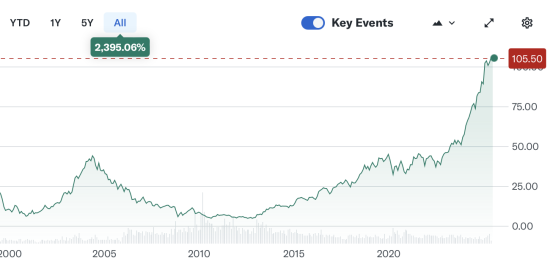
At one point last decade, I sort of assumed Boston Scientific had become a perennial loser, one of those has-been companies whose best days were permanently behind it, sort of like Digital Equipment, Wang Laboratories, GE etc., etc. But guess what? Boston Scientific is back. And it’s now Massachusetts’ most valuable public company, helped by a 19 percent stock price gain since the start of the year and a corresponding loss of 21 percent by reigning local king Thermo Fisher, as the BBJ reports. … Take a gander at BS’s stock performance since 2000, starting the new century at a low of $6.44 a share, then experiencing a brief bump around 2004 before collapsing again to $5.14 in 2012. But it’s been a mostly steady-eddie climb since then. Impressive. … BSX stock chart via Yahoo Finance.Update – Here’s a look at BS’s revenue numbers since the mid-1990s. Notice the 2008-2013 revenue slump, followed by a subsequent rise fueled most recently by a major acquisition spree. They threw money at the growth problem — and some of it stuck.
Update II — 5.22.25 – And some things never change. From the BBJ: “Boston Scientific CEO buys Palm Beach County mansion for $17 million.”
-
The two factions behind Ray Flynn: the ‘Sandinistas’ and the old Southie/Dorchester crowd

Ray Flynn and family, election-night victory party, 1983. As promised, here’s the last of Brighton Reader’s thoughts on former Mayor Ray Flynn, who BR argues wasn’t the father of modern Boston progressivism as recently portrayed in this Globe op-ed and later discussed by Hub Blog here and here. Simply put, Flynn was more complicated than any single label. He was part liberal, part populist, part deeply conservative Catholic, as Brighton Reader remembers him. From BR:
“During Ray Flynn’s first campaign for mayor in 1983, Peter Lucas labeled him the ‘Lech Walesa of Boston politics.’ He was sometimes called a populist, given his working class background, focus on neighborhoods, support for unions, and for rent control, too. He was out in the neighborhoods as a city councilor, and a publicity hound. Both traits continued as mayor, sometimes going into the ridiculous (grabbing a fire extinguisher from a Santa Claus!?). But Ray first made his mark as a state rep with relentless opposition to legal abortion. That issue gave him the attention that got him onto the Boston City Council and ultimately led to his the candidacy for mayor. …
“During Flynn’s first winter storm as mayor, he hopped in a plow alongside the driver, reporters from the then robust Boston media corps (tv stations! Newspapers! Radio stations!) went along for the ride. It was a hallmark of his mayoralty, the streets were plowed, the parks improved, street cleaning and resident parking expanded, abandoned cars were towed.
“There were two ‘factions’ in the Ray’s first term, those on the left were called ‘Sandinistas.’ The other didn’t have a name, as I remember, but were the South Boston/Dorchester people who had supported him for years, also the pro-life people from across the city. The Sandinistas were mainly activists, not from Boston, who supported him based on things like rent control and linkage, and had gotten to know him after he became a city councilor. Ray Dooley, Flynn’s campaign manager, seen as the leader of them, became head of a the Department of Administrative Services. At the time, this role made him the most important department head, overseeing the budget, with lots of influence on city policy. Having been campaign manager, he had a good relationship with Flynn, which gave him even more influence. He could get people hired throughout city government.
“Joe Fisher, Flynn’s trusted confidant, was the most influential of the other group. His desk was just outside of Flynn’s office. He was another person with lots of influence on policy, hiring, who got what. He didn’t oversee any department directly, he was a ‘special assistant’ to the mayor. He landed in jail for taking bribes.
“Btw – Ray Flynn and Billy Bulger were both from South Boston. They did not much care for each other.”
Photo above via city of Boston archives.
-
The Trump 10/90 Rule, as applied to Black history

And, yet again, here’s another example of the Trump 10/90 Rule at work, i.e. when Trump may hold a view that has a 10 percent kernel of truth to it, but then he goes 90 percent overboard in reaction to it. The NYT’s John McWhorter explains why, for example, Trump may have legitimate complaints about doctrinaire aspects of DEI and woke-ism – but then he gets it completely wrong when he goes after the Smithsonian Institute’s National Museum of African American History (see image above). … Btw: McWhorter heaps high praise on how the museum handles Black history, saying its “teachings are never strident or rhetorical.” -
‘It’s all right to mourn, Celtics fans’
The Globe’s Christopher Gasper and the Herald’s Zack Cox provide the postmortems on the end of the Celts season – and the end of an era due to the CBA and likely dismantling of the team to avoid further luxury-tax hits. … I particularly liked Jaylen Brown’s appeal to Bostonians not to give up on the team moving forward (see Gasper’s piece). I also liked Derrick White’s comments at MassLive. He knows major changes are coming. From Derrick:
“I just love playing with the guys that we have in that locker room,” White said after game 6. “Just a great group of guys that compete at a high level. Off the court we just had a lot of fun. And I think that’s just what I’ll probably (be) the most proud of, is just being able to say that I put on a Boston Celtics uniform with some amazing group of people, you can go down a list of every person who has been on the Celtics since I’ve been here. That’s probably what I’m most proud of.”
-
Are we headed toward a ‘hybrid’ form of government, part democracy, part autocracy? It looks like it
Ezra Klein at the NYT hosts a fascinating discussion with Zack Beauchamp, who recently wrote a piece in Vox called “Trump Is Losing,” and Andrew Marantz, who recently wrote “Is it Happening Here?” in the New Yorker. The topic: whether Trump is winning in his quest to reshape American democracy, creating a strongman like government along the lines of what’s happening in Hungary. … After witnessing the administration’s latest we-don’t-like-your-politics attack on an institution and so many other outrageous actions, I’m with Marantz, who has studied Hungary under Viktor Orbán and who argues the evolution toward a form of autocracy isn’t a straight line from here to there, one heavy-handed assault on democracy after another. It’s more gradual and piecemeal, one many people don’t recognize as it happens because they’re not immediately effected. … The end result isn’t a clear-cut case of dictatorship replacing democracy, Marantz says. It’s more like a “hybrid regime,” part democratic, part autocratic, or what some call “competitive authoritarianism,” in which elements of democracy survive alongside strongman-style government. That’s where we’re headed, I fear, and I don’t see future presidents giving up the new powers that Trump has grabbed. New precedents aren’t easily reversed.
-
Ray Flynn’s legacy, Part 2: is it really Kevin White’s legacy?
As promised, here’s some more of Brighton Reader’s thoughts on whether former Mayor Ray Flynn was really some sort of seminal figure who first lit and then passed the torch of progressivism to Tom Menino, Marty Walsh and ultimately Michelle Wu, as Don Gillis asserts in this Globe op-ed. Brighton Reader doesn’t think so, as he mentioned earlier this week on Hub Blog. The term ‘progressive,’ as it’s understood today, simply doesn’t apply to mayors prior to Michelle Wu, he argues. But if there was such a past pioneering progressive mayor, Brighton Reader argues it wouldn’t be Flynn:
“Who was the mayor who instituted strong rent control, hired the first Black commissioner of a city department, hired one of the first liaisons (maybe the first?) to the gay community in the country, established a network of offices in neighborhoods to make city government more accessible, opposed a major federal highway project when such opposition was to put you in the path of ‘progress,’ fought Logan Airport’s expansion, and sponsored summer events (Summer Thing) in the neighborhoods? Kevin White. Ray Flynn’s predecessor. Oh, and by the way, he also hired Fred Salvucci, Barney Frank, Peter Meade, and many other ‘liberals,’ as those on the left were called back then. Not sure where any of them would fall on today’s ideological spectrum, then or now.”
 Hub Blog