As the multibillion-dollar college football season gets set to start in a few weeks, Scott Hodges, the president emeritus of the Tax Foundation, writes at the Washington Post that’s it’s time to strip the NCAA of its nonprofit, tax-exempt status and call it what it is: a money-making machine. … He’s right. College sports long ago became big business, wrecked by overpaid college administrators, coaches, athletic directors, NCAA honchos, TV executives, athletic-apparel merchants, and, lately, private-equity firms. Amateur athletics at the top collegiate levels is dead. … And now greedy grown-ups are increasingly turning their for-profit eyes to youth sports. From a recent NYT piece: “Youth Sports Are a $40 Billion Business. Private Equity Is Taking Notice.” …
Among local investor-backed companies mining the youth-sports bonanza: 3 Step Sports. … They’re all making a buck off kids who aren’t paid a dime. You can’t get cheaper labor than youth athletes, right? … Think about this next time you see a Little League tournament playing on ESPN. It’s not NCCA Division 1 level sports. But, hey, if grown-ups can squeeze a buck or two out of these kids, why not?
There’s so much to like about Medford’s recently passed zoning reforms designed to boost housing construction, including making it easier to build multifamily housing in commercial zones. But as B&T’s Steve Adams reports, there’s now intense controversy in Medford surrounding a proposal to make it easier to build multifamily housing in existing single-family districts. … Sounds like the mayor is right: the reform proposals now on the table go too far and city officials need to slow down on making changes. …
I’ve harped on this general issue before as it relates to recent Cambridge zoning changes. My main concern: if done wrong, housing reforms can create a backlash, discrediting reform efforts and strengthening NIMBY forces in the process. … An example of getting it wrong: allowing developers to knock down existing single-family homes, or knock down small double- or triple-deckers, to build larger multifamily-housing projects in predominantly single-family neighborhoods. It’s a policy sure to ignite controversy, particularly if it happens in historic areas and/or already densely packed urban-like neighborhoods. … Maybe restrict knockdowns? Limit new multifamily projects to only two or three units (i.e. triple-deckers) if they’re in a previously designated single-family district? … Just throwing out ideas.
Well, maybe not everything. But the BBJ’s Lucia Maffei, after a visit to Commonwealth Fusion’s facilities in Devens, has a good explainer piece on fusion energy and why the company is so confident about its future. … I had no idea Commonwealth Fusion employed so many in Devens. The operations there are huge (see company photo above). … Btw: Google is obviously excited about fusion energy. And, unfortunately, so are the Chinese, as this piece at the Hill makes clear.
Nvidea and AMD have separately negotiated deals with the Trump administration to give the U.S. government a 15 percent cut on their AI chip sales to China in exchange for landing necessary export licenses, as Reuters reports. The WSJ is describing the multibillion-dollar deals as unusual and a sign of deepening ties between the firms and the feds. … But isn’t this effectively an export-license tax — or a corporate tax in general? Where’s Congress in all this? … Similar questions are being raised about Trump’s unilateral tariff moves – with Trump typically trying to bully his way around those thorny constitutional questions.
As if on cue, from Greg Ip at the WSJ: “The U.S. Marches Toward State Capitalism With American Characteristics.”
Update — 8.12.25 — Also from the WSJ: “Now Trump Wants an Export Tax.” … And more on from the State Capitalism front, via CNBC: “Trump tells Goldman Sachs CEO David Solomon to replace economist over tariff predictions.”
After reading these various stories about mega-housing development proposals in Braintree (752 units – B&T), Dedham (644 units – B&T) and Cambridge (2,000 units – Boston.com), I actually entertained the idea that maybe, just maybe, we had turned a mysterious corner when it comes to housing production in Massachusetts. That maybe an early trend was emerging of towns and developers finally working together for the greater common good. And then … and then I was brought to my senses with news of a possible rent-control referendum on next year’s election ballot. When it’s not NIMBY types getting in the way of new housing developments, it’s “housing advocates,” via antiquated policies that discourage new housing developments. … I hate to say it, but the whining real estate groups (via Globe) are right about a statewide rent control law: it would be disastrous for Massachusetts. Those housing plans mentioned at the outset of this post? Not going to happen if one of the most restrictive rent-control policies in the nation is passed next year.
In an ideal world, “housing advocates” would read this WSJ article about how New Rochelle, NY, is actually bringing rents down — without affordable-housing requirements, rent controls, etc., etc — and perhaps adjust their strategies. But that’s not going to happen. It’s not how ideological minds work.
Reading this WSJ article about the behind-the-scenes battle between Intel CEO Lip-Bu Tan and board chair Frank Yeary, amid President Trump’s call for Tan to resign, reminds me of the sad fate of our very own Digital Equipment Corp. (DEC). Both Digital and Intel were once colossal giants within their respective tech sectors – giants that went into spectacular nosedives after failing to see looming market trends. Digital ultimately spent years in turmoil, thrashing this way and that, before selling off to Compaq in 1998. Intel, which recently sold off its former chip facility in Hudson, is still in its own turmoil stage, searching for ways to survive and revive. … What is its future? I’m actually rooting for Tan to succeed. He’s not giving up on Intel’s core chip businesses. But I fear Yeary, a former investment banker, might be right about the need to effectively pack it in.
Update – Tan is defending himself afterTrump’s public demand he step down due to his China ties.
Update II — 8.12.25 – From the WSJ: “Forget the White House Sideshow. Intel Must Decide What It Wants to Be.”
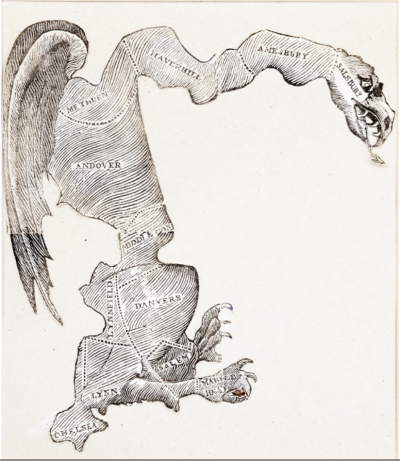
The Globe is trying its very best to discredit President Trump’s assertion that Massachusetts lawmakers have gerrymandered the state’s congressional districts in order to prevent Republican representation in the state. It’s easy to poke holes in the president’s argument – especially if you cherry-pick the numbers like the Globe does. Sure, the president is dead wrong, not to mention typically bombastic, to suggest that his 36 percent (not 40 percent) presidential vote performance in 2024 in Massachusetts should somehow translate to a roughly corresponding number of GOP-held congressional seats in the state. That’s not how redistricting and elections work. But to rule out, or downplay, the role of political gerrymandering in Massachusetts? In the very state that gave us the word “gerrymander”? In the very state in which a former Massachusetts House speaker was charged with lying under oath about his role in redistricting in 2001? Please. If you really believe Democrats in this one-party, bluest-of-blue states haven’t engaged in systemic gerrymandering for partisan reasons over the decades, then I have a few bridges to sell to you in Brooklyn and Boston.
As the Princeton Gerrymandering Project reports, computer simulations show that Massachusetts Republican voters are so few in number today and “so evenly distributed around the state that drawing a Republican congressional district is impossible.” So take that, President Trump. Then again, that’s not to say maps aren’t drawn to heavily favor Dems, dramatically reducing the odds of any surprise GOP congressional victories. After all, as the Princeton Gerrymandering Project also notes, redistricting here is indeed “under single-party control by Democrats” – and they’ve largely dominated the redistricting process here for well over half a century.
Let’s set aside the fact that Massachusetts hasn’t elected a Republican to the U.S. House for 31 years. Let’s look at our Massachusetts legislature, which is charged with drawing up new congressional and legislative maps every ten years and sending a final plan to the governor. Care to guess how long Dems have dominated both legislative chambers on Beacon Hill? Answer: since 1959, when Dwight D. Eisenhower was still president and Foster Furcolo was sitting in the corner office. Do you really think redistricting has had nothing to do with this multi-generational dominance by Democrats? Nothing?
I’m not saying redistricting is the sole reason Dems have been so politically dominant in Massachusetts over the decades, both at the congressional and legislative levels. Other factors are at play, including a statewide electorate that’s genuinely become more liberal over the years (particularly after Vietnam and Watergate) and a Massachusetts Republican Party that’s become ever more incompetent.
But partisan redistricting – and partisan redistrictings on top of partisan redistrictings – have cumulatively helped grind the Mass GOP into political dust and reinforce Dem control of Beacon Hill and the state’s congressional delegation. The partisan competitiveness has gotten so bad in Massachusetts that most legislative incumbents (i.e. Dems) face no opposition in general elections – and congressional races aren’t that much better.
As much as I hate to admit it, Donald Trump isn’t completely wrong to complain about the effects of our partisan redistricting process in Massachusetts.
I’m not wild about the strike by bar advocates over their pay. But at the same time they are paid considerably less than their counterparts in other New England states — and the bill just signed by Gov. Healey doesn’t adequately address that disparity. The state’s counterproposal comes across as a take-it-or leave-it offer with more than a little spite. Unfortunately, bar advocates will probably respond with their own righteous spite. …
Just a passing thought: Why didn’t lawmakers show similar frugalness when the state was blowing through billions of dollars on emergency shelter programs?
Via Scott Van Voorhis, we learn that some of our state Democratic leaders, including Gov. Maura Healey, are fans of the book ‘Abundance,’ which basically argues blue state pols haven’t been managing blue states all that well over the years. Here’s hoping local leaders take some of the ‘Abundance’ lessons to heart, as they apply to housing, energy, and transportation issues, etc. … And here’s hoping they might also apply ‘Abundance’ lessons to the increasingly radical agenda of the Massachusetts Teachers Association, which, every day, seems to be testing and pushing the limits of its power in Massachusetts. The union’s latest political antic: sinking a million bucks into local school-committee elections, as Contrarian Boston also reports. That effort comes as the MTA explores backing yet another new wealth tax to pay for free public colleges, pushes to legalize teacher strikes (while backing illegal teacher strikes), fends off repeated accusations of sponsoring antisemitic initiatives and politicizing school curriculums, revels in past political wins involving MCAS, charter schools, the millionaire’s tax, etc., etc. … Considering how much the MTA has pumped into Dem campaign coffers over the years, it’s unlikely Dems will stand up to the union any time soon. But it sure would be nice if they could at least firmly say ‘no’ to the MTA now and then.
Update – 8.11.25 – From the Globe: “State’s largest teachers union makes big play to influence more municipal elections.”
So Harvard is bristling over the $50 million deal Brown University recently cut with the Trump administration, as the NYT reports. Can’t blame them. Harvard is looking at a deal that could cost it $500 million, or ten times more than what Brown is paying. It’s not fair. It doesn’t make sense. But of course it’s not fair. And of course it doesn’t make sense. That’s because Harvard is dealing with an irrational, unpredictable, impulsive president surrounded by hand-picked loyalists whose top priority is to obey his every irrational, unpredictable, impulsive demand. The president has privately decided Harvard must pay more for its transgressions, and so it must be, his followers have concluded. …


 Hub Blog