Fun stuff from Dion. …. Just a thought: A follow-up strike to the south could bag Quincy and Milton as well.
Update – I should point out that my Hub Blog tech advisor (i.e. my nephew) originally sent me the Dion link with a suggestion of further expansion: “Annex the Hub of the Universe, why not?” … I initially assumed he was referring to annexing UH — a truly provocative thought. Or was he referring to Hub Blog annexing all of Boston?
Now this is insider trading
Want to see real insider trading? Check out Larry Edelman’s latest Globe piece: “Breaking bad: Ex-Goodwin Procter lawyer allegedly ran a decadelong insider-trading scheme.” … The feds say he and a pal allegedly traded on M&A info – and it involved dozens of deals. From Larry:
Local deals cited in the indictments include Amazon’s $1.7 billion bid in 2022 for iRobot, the Bedford maker of Roomba vacuums, which it later called off; Johnson & Johnson’s buyout of Cambridge-based Momenta Pharmaceuticals for $6.5 billion in 2020; and IAC’s purchase of Waltham’s Care.com, the online platform for babysitters and other caregivers, for $500 million in 2019.
Betting on future military action is not ‘insider trading.’ It’s gambling with lives and national security
The WSJ and 60 Minutes (video here) had excellent pieces over the weekend about military insiders using the new “prediction markets” to bet on future military actions by the U.S. – and how they’re giving new meaning to the phrase “war profiteering.” But my complaint is with those who describe the acts as a form of “insider trading,” buying into the farce that prediction markets are “trading in commodities” and in need of firmer regulation by the Commodities Futures Trading Commission. … But Kalshi, Polymarket et gang are gambling operations – and everyone knows it except some lawyers and judges who can’t think their way out of legal-definitional corners that they’ve painted themselves into. In fact, military insiders betting on future military actions should be charged with criminal disclosure of classified information, espionage or even treason, not slapped on the wrist by the CFTC. They’re literally gambling with American lives and national security. It’s sick. …
Btw: How weird are the prediction markets? Cryptocurrency holders are now empowered to arbitrate some prediction-market “trade” disputes, such as fights over an Israel-Hezbollah cease-fire, as the WSJ reports. … Prediction markets and cryptocurrency combining forces. Quite a pair, huh? There’s got to be a WWE angle here somewhere. Maybe here?
Update — 5.24.26 – From the NYT: “How Prediction Markets and Crypto Firms Steamrolled a Watchdog Agency”
‘Byzantium’: An old-fashioned book sale find
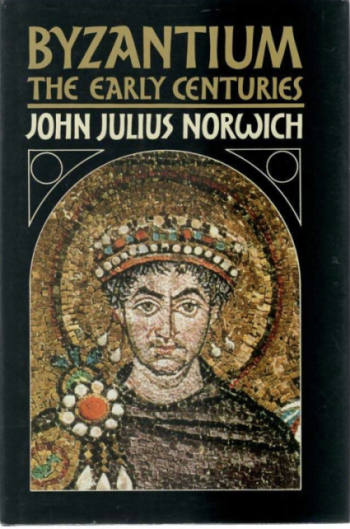
A while back, the hopeless history buff in me decided to buy a used copy of John Julius Norwich’s ‘Byzantium: The Early Centuries’ at a Hudson Public Library book sale, hauling it and other dusty two-buck specials back to my house, where it proceeded to sit for years on a pile of unread books in my home office. (Yes, a book pile, not a bookcase.) I can’t say I had buyer’s regret, not at $2, but I did feel a little guilty every time I walked past the book pile and there staring up at me was the mosaic portrait of Emperor Justinian on the cover of ‘Byzantium,’ as if beseeching me to give the poor book a chance. “I don’t know why I bought you,” I’d think. “I’m never going to read you. Not at 800 pages.” … But, of course, I eventually did, after one day forcing myself to read Norwich’s introduction in which he charmingly admits he was once a Byzantine Empire dolt like the rest of us and wanted to write a book spreading the word about an underappreciated period in Western history.
And it’s all there: Emperor Diocletian’s division of the Roman Empire into East and West, the rise of Constantine the Great, the First Council of Nicaea and the emergence of modern Christianity, the long and critical reign of Justinian I, the transformation of a small outpost city into a magnificent capital of an empire that lasted more than 1,100 years.
For an 800-page book published in 1988, ‘Byzantium’ is a remarkably accessible and easy read, a true “popular history” that the late Sir John Julius Norwich was apparently famous for during his long career. All these years after its publication (and then sitting on my book pile), I can definitely recommend it to others, particularly to fellow book hounds who head straight to the history/biography tables at local library book sales. I’m not sure when, or if, I’ll ever tackle the other books in his Byzantine trilogy. But it was satisfying knocking off at least one of them.
Headlines of interest: … Wu vs Blacks? … Jack ‘Dude’ Schlossberg … Nvidia’s new Boston fixation… City’s Mean Girl Problem … Autonomous Navy ships … Auctioning off conversion rights … ‘Checkmate in Iran’
Some slightly off-the-beaten-path stories you may have missed over the past week:
If Ed Markey and Maura Healey are doing it, you know it’s a trend (or close to a trend), i.e. Democrats downplaying climate change on the campaign trail, something that Matthew Huber (NYT) advises Dems to do in these affordability times. The Globe’s Sam Brodey has more on the magical disappearance of Markey’s Green New Deal. Meanwhile, Commonwealth Beacon’s Jordan Wolfman reports on Healey’s shift to the center on climate change/energy issues. … Re Huber’s Times piece: Gotta love his reference to the “Brahmin Left,” via the Quarterly Journal of Economics.
Ah, what the heck. Might as well throw in Shirley Leung and Jon Chesto’s piece on business groups backing Seth Moulton. They’re concerned about the state’s sagging life-science sector. … Sudden passing thought: Is Markey partly reacting to Moulton’s unenrolled voter strategy?
Targeting a primary problem in Massachusetts: party primaries
The Globe’s Chris Van Buskirk has a good piece on the push to eliminate party primaries in Massachusetts – and how it’s dividing state Democrats. … Did you know that former Gov. Deval Patrick is among those supporting the shift to non-partisan primaries in the state? I’m impressed. But here’s a non-surprise: many progressives (though not all) are against the switch. In a way, can you blame them? They love the current primary status quo precisely because it gives them a disproportionately large influence over the state Democratic Party — a party that itself represents only 25 percent of enrolled voters and yet controls all six statewide elected offices and 11 Congressional seats while maintaining a super-majority in a Massachusetts Legislature that Dems have dominated since 1959. Today, winning election to office in Massachusetts increasingly means winning a Dem primary, since the hapless MassGOP regularly doesn’t field candidates in general elections. So, yes, many progressives, such as Robert Kuttner, support the current status quo, even though it has contributed to 51 percent of all elections in Massachusetts going uncontested since 2014.
Do I think non-partisan primaries are the cure-all to the state’s current political and governmental woes? Nope. But it sure would shake things up in a state that desperately needs shaking up. I’ll let Danielle Allen, a Harvard professor and former gubernatorial candidate, explain the main pluses of scrapping the current party-primary system (Globe). … I’ve previously harped on our flawed primary system here and here …
Jaylen Brown’s gaffe: telling the truth about his ‘favorite season’
Jaylen Brown should be praised for having his best season ever with the Celts. He deserves credit for leading a team that outperformed all pre-season expectations. He deserves to be considered for league MVP and All-NBA. He’s earned the right to be proud. So why is he being criticized by Stephen Smith and others for saying this past year was his ‘favorite season’? The answer: he committed a classic Kinsley gaffe by telling the truth. He wasn’t supposed to say or even hint he enjoyed the spotlight without Jayson Tatum. He wasn’t supposed to say he enjoyed being the team leader. He wasn’t supposed to distantly suggest, as many others have, that there might be chemistry problems when he and Tatum are on the court together. He blurted out truths. … And it’s those truths that suggest another truth: that, yes, maybe it’s time to break up the Brown-Tatum duo. … A Brown trade for Giannis Antetokounmpo? I’d take it in a second. For that matter, I’d be open to trading Tatum for the right price. But that still leaves us with the stubborn Joe ‘Process’ Mazzulla problem.
I like Queta but I don’t think he’s a starter. They need to go find that All-Star-caliber big. If I’m the Celtics, do I break up JB and JT? No. But if a Giannis Antetokounmpo becomes available, I might have to think about it. Or if Anthony Davis is feeling some type of way as a Washington Wizard and you could package something up and bring him to Boston.
Re yet another proven Celts problem, there’s this from Gary Washburn in the same piece:
Of the top 12 teams in 3-point attempts this season, only five reached the playoffs and just two, the Knicks and Cavaliers, are still playing. The three teams that shot more 3-pointers than the Celtics during the regular season were the Warriors, Hornets, and Trail Blazers. Only Portland reached the playoffs.
Will someone in the organization please point this out to Stubborn Joe?
Is Moulton’s unenrolled strategy working? Maybe. Just maybe.
The new Emerson poll showing Seth Moulton within 5 points of Ed Markey in the Dem primary for U.S. senator is so out of sync with other polls that it’s easy to dismiss it. Except … except it makes a little sense when you drill down into the numbers and see Moulton picking up support from unenrolled voters – the type of voters the more moderate Moulton needs to win in a Dem primary and the type of voters he’s been courting in recent months (Globe). … Anyway, GBH’s Adam Reilly and the Herald’s Tim Dunn have more on the surprise Emerson numbers. …
Btw: the same Emerson poll shows the income-tax cut and rent-control referendums attracting big support.
Update — A reader wonders if the big bucks “Chronic Reelection Disorder” campaign (Globe) is helping Moulton.
Headlines of interest: … Auchnincloss’s NYT fan club … Boston Market’s Market Basket problem … Mass. referendum primer … Stanley toolmaker, adieu … Eliminating one-party hegemony … ‘Doing nothing’
— First Ezra Klein. Now Bret Stephens. Auchincloss seems to have a growing fan club at the NYT: “A Democrat Who Makes Me Listen” (NYT)


 Hub Blog