
It all started with an article on James Polk’s portrait now hanging in President Trump’s office, followed by conversations with a few relatives and friends about how little we knew about U.S. history stretching from roughly the end of Andrew Jackson’s term in office (1837) to the Civil War era under Abraham Lincoln (1861-1865). Presidents William Harrison, John Tyler, James Polk, Zachery Taylor, Millard Fillmore, Franklin Pierce, James Buchanan? They’re mostly a blur to me. Sure, I know about many of the great events that led up to the Civil War, but not much else.
Well, I’ve just finished filling in some of my history-buff blank spots by going on a reading tear, starting with a biography of James Polk and unexpectedly drifting into a larger crash course on the history of the U.S. Southwest in the early years of its American conquest and settlement. Here’s a quick review of each of the four history books I’ve recently tackled, in between various Michael Connelly, Don Winslow, John MacDonald diversions, etc.
A Country of Vast Designs: James K. Polk, the Mexican War and the Conquest of the American Continent, by Robert W. Merry. Guarded thumbs up recommendation. – This is a hard-core history buff’s read, but it’s worth it. Polk politically came out of nowhere to oversee the largest territorial expansion in U.S. history, via the Texas annexation, Mexican War and Oregon Territory treaty with Great Britain. Many of Polk’s actions were controversial at the time – and remain controversial to this day.

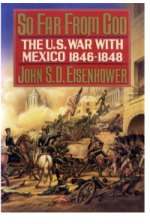
So Far from God: The U.S. War With Mexico, 1846-1848, by J.D. Eisenhower. Thumbs up recommendation. – Reading Merry’s biography of Polk made me realize how little I knew about the Mexican War. So next up was a straightforward military history of the conflict by none other than J.D. Eisenhower, the son of the WWII general and president. They’re all there: Zachary Taylor, Winfield Scott, John C. Fremont and others who helped rip away from Mexico the future states of California, Nevada, Utah, Arizona, New Mexico, and parts of Colorado, Wyoming, and Oklahoma.
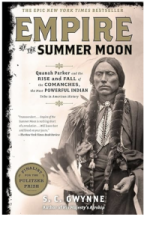
Empire of the Summer Moon: Quanah Parker and the Rise and Fall of the Comanches, the Most Powerful Indian Tribe in American History, S.G. Gwynne. Big thumbs up. – My favorite of the four books was recommended by a friend – and I can’t praise Empire of the Summer Moon enough. Talk about filling in historical blank spots. The Comanches were the regional Spartans of their day, militarily feared by all in the Southwest – Indians, Spanish, Mexicans, Americans. The tribe’s long and brutal confrontation with Texans and later Americans should almost be called The Forty Years War. But this book is much more than a military history. It’s a sweeping, eye-opening, multicultural history of the Southwest in general.*
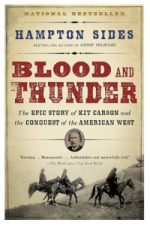
Blood and Thunder: The Epic Story of Kit Carson and the Conquest of the American West, by Hampton Sides. Big thumps up. – This is my second favorite of the four books I read, recommended earlier this fall by a friend after I raved to him and others about how much I liked Empire of the Summer Moon. It’s another sweeping, multicultural history of the West and Southwest, using the great frontiersman Kit Carson as a focal point to tell a much larger story about so many other fascinating people and events. The end of the book, in which the Navajo nation finally succumbs to U.S. military forces and is subjected to a form of ethnic cleansing, is beyond sad. And as much as Hampton clearly and justifiably admires Carson (as do I after reading this book), there’s no escaping his faults and role in the Navajo tragedy. What a complex legacy and history.
And that’s Hub Blog’s crash-course reading list on U.S. Southwest history. Just thought I’d pass it along to fellow history buffs who might be interested.
* Note: While reading Empire of the Summer Moon, I remembered I had not so long ago read Forget the Alamo: The Rise and Fall of an American Myth, a revisionist history of the Alamo and the Texas origins story. The three authors go a little overboard, coming close at times to mocking the courage of some historical figures. But their main point is convincingly made: Texas’s early history was intricately intertwined with slavery — and white Texans’ determination to maintain the institution of slavery.
 Hub Blog