
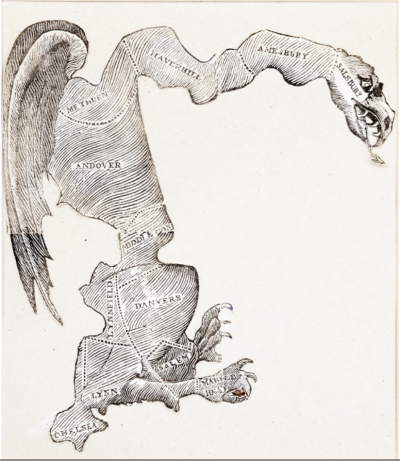
The Globe is trying its very best to discredit President Trump’s assertion that Massachusetts lawmakers have gerrymandered the state’s congressional districts in order to prevent Republican representation in the state. It’s easy to poke holes in the president’s argument – especially if you cherry-pick the numbers like the Globe does. Sure, the president is dead wrong, not to mention typically bombastic, to suggest that his 36 percent (not 40 percent) presidential vote performance in 2024 in Massachusetts should somehow translate to a roughly corresponding number of GOP-held congressional seats in the state. That’s not how redistricting and elections work. But to rule out, or downplay, the role of political gerrymandering in Massachusetts? In the very state that gave us the word “gerrymander”? In the very state in which a former Massachusetts House speaker was charged with lying under oath about his role in redistricting in 2001? Please. If you really believe Democrats in this one-party, bluest-of-blue states haven’t engaged in systemic gerrymandering for partisan reasons over the decades, then I have a few bridges to sell to you in Brooklyn and Boston.
As the Princeton Gerrymandering Project reports, computer simulations show that Massachusetts Republican voters are so few in number today and “so evenly distributed around the state that drawing a Republican congressional district is impossible.” So take that, President Trump. Then again, that’s not to say maps aren’t drawn to heavily favor Dems, dramatically reducing the odds of any surprise GOP congressional victories. After all, as the Princeton Gerrymandering Project also notes, redistricting here is indeed “under single-party control by Democrats” – and they’ve largely dominated the redistricting process here for well over half a century.
Let’s set aside the fact that Massachusetts hasn’t elected a Republican to the U.S. House for 31 years. Let’s look at our Massachusetts legislature, which is charged with drawing up new congressional and legislative maps every ten years and sending a final plan to the governor. Care to guess how long Dems have dominated both legislative chambers on Beacon Hill? Answer: since 1959, when Dwight D. Eisenhower was still president and Foster Furcolo was sitting in the corner office. Do you really think redistricting has had nothing to do with this multi-generational dominance by Democrats? Nothing?
I’m not saying redistricting is the sole reason Dems have been so politically dominant in Massachusetts over the decades, both at the congressional and legislative levels. Other factors are at play, including a statewide electorate that’s genuinely become more liberal over the years (particularly after Vietnam and Watergate) and a Massachusetts Republican Party that’s become ever more incompetent.
But partisan redistricting – and partisan redistrictings on top of partisan redistrictings – have cumulatively helped grind the Mass GOP into political dust and reinforce Dem control of Beacon Hill and the state’s congressional delegation. The partisan competitiveness has gotten so bad in Massachusetts that most legislative incumbents (i.e. Dems) face no opposition in general elections – and congressional races aren’t that much better.
As much as I hate to admit it, Donald Trump isn’t completely wrong to complain about the effects of our partisan redistricting process in Massachusetts.
Note: The image above is of the original “political cartoon that gave birth to the term ‘Gerrymandering.’
Update – From the Globe’s Jeff Jacoby: “End the gerrymandering wars by enlarging the US House.”
 Hub Blog